Categories
Energy News

New Legislation Targets Large Energy Users, Relieves Electric Grid Strain

Bill will protect ratepayers from new generation costs by decreasing energy demand pressure on Indiana utility companies

INDIANAPOLIS, IN (Jan. 14, 2026) – New legislation was introduced today to strengthen Indiana’s energy market by giving major employers new options to manage electricity costs — while protecting residential and small business ratepayers from growing energy demands. The bill, Senate Bill 272 introduced by Sen. Stacey Donato, allows commercial and industrial companies to purchase electricity supply from an energy market rather than being limited to a single utility option, helping employers better navigate rising and volatile energy costs.

“Indiana’s economic future depends on having reliable, affordable electricity,” said the bill’s sponsor, Sen. Stacey Donato. “This legislation gives our largest employers the flexibility to procure their own electricity and manage those costs. This is a balanced approach that protects consumers, attracts privately funded power generation, and helps ensure our state has the power it needs for the future.”

The Retail Energy Advancement League (REAL), a national organization advocating for energy market expansion and consumer choices, applauds Sen. Donato for championing legislation that will provide commercial and industrial businesses with a choice in their power supply.

“The concept is simple: allow large energy users to have direct access to an energy marketplace to meet their electricity needs the same way utility companies do,” said Chris Ercoli, president and CEO of the Retail Energy Advancement League. “Allowing large energy users to access competitive electricity supply is a practical solution that can reduce their cost pressures, encourage new power generation from independent power producers, and ease the strain on utility systems — benefiting all ratepayers in the long run. We applaud Sen. Donato for her comprehensive approach to help support Indiana’s energy needs.”

Electricity remains one of the top operating expenses for many manufacturers and industrial employers. When those costs rise unpredictably, it threatens jobs, wages, and future investment in Indiana communities.

Energy-intensive businesses are particularly sensitive to electricity prices. States such as Michigan and Kentucky already allow large energy users to purchase electricity supply from an energy market — providing significant cost savings and giving those states a competitive edge in attracting and retaining major employers.

HOW RATEPAYERS CAN BENEFIT

In Michigan, 10 percent of a utility’s customer load is permitted to procure their own electricity. That cap has been fully subscribed since 2008, with more than 5,000 commercial and industrial customers served by a third party supplier. As of 2023, there’s an additional 5,000 customers in the queue waiting to participate in the program. This program has reduced the amount of power generation the utility needed to build and maintain by 2,798 MW –– the equivalent of four natural gas plants that could have cost all ratepayers $3.2 billion for the utilities to build

In 2023, the commercial customers that purchased from a competitive supplier saved more than $150 million compared to the utility’s commercial rate in Michigan, according to data from the U.S. Energy Information Administration. 

WHAT SENATE BILL 272 DOES

Under current Indiana policy, most customers receive electricity supply exclusively from their designated utility, concentrating growing demand on utilities and driving costly new generation investments that are ultimately passed on to ratepayers –– customers.

Senate Bill 272 allows large energy users — including manufacturers, steel producers, and technology companies — to purchase electricity supply directly from a competitive provider while continuing to pay utilities for transmission and distribution. Residential and small business customers would continue to receive service as they do today. 

As energy demand grows and older power plants retire, utility obligation to build new generation is increasing, at significant cost. Allowing large energy users to procure their own electricity helps utilities meet that obligation with private capital, which protects ratepayers and  strengthens grid reliability.

Senate Bill 272 represents a commonsense step toward a more resilient energy future for Indiana — one that shifts the cost of meeting new energy demand from all ratepayers to the companies that want and need new energy.

Categories
Energy News

The Real Story Behind Electricity Price Comparisons

When it comes to measuring the success of energy markets, one metric often gets the most attention: price per kilowatt-hour (kWh) of electricity. On the surface, this simple way of comparing prices might seem like the best way to compare state electricity market success. But in reality, focusing solely on this number paints an incomplete picture. 

True market success goes beyond just the price per kWh because the price per kWh represents a bundled cost of one unit of electricity consumed. That cost incorporates fees, taxes, and distribution charges that are unique to each state and utility. It also doesn’t weigh a state’s access to different generation assets, which can easily alter the price. 

Context is needed when comparing raw data from state to state. Without it, the price rankings often reported on in news stories leave consumers with apples-to-oranges comparisons.

Price Isn’t the Same as Price Performance

Price per kWh is a snapshot of cost at a specific time and day, rather than an overall consumer value. It doesn’t account for the factors that drive long-term performance, resilience, or innovation the way that price performance does.

Price performance looks at how well a market delivers value relative to cost over time, which is missing when only considering price per kWh. 

States also cannot be equally compared just on price because no two states are the same. Consumers’ electric bills are comprised of a variety of different charges, many of which are directed by the state legislature.

Massachusetts is a state that demonstrates the difficulty in comparing prices to other states. The average residential electricity rate for Bay-Staters is just north of 30¢/kWh, ranking Massachusetts as the state with the third-highest average rate. According to WhatsInMyElectricBill.com, nearly 30% of a Massachusetts electric bill is public policy charges: residential assistance programs, energy efficiency, and renewable energy requirements. About 40% of the bill is the average distribution and transmission charge across the two main utilities. That leaves only about 30% of the bill for the actual cost of the electricity purchased and used.

By comparison, Idaho ranks number one for the best rate at less than half of Massachusetts’. Consumers in Idaho are required to pay for energy efficiency charges and even the closure of a coal plant; but the actual cost of the electric source is tiered into pricing levels for Idahoans based on energy usage and the time of year they are using it. 

Each state legislature and investor-owned utility has its own policy beliefs and priorities, which create differences among state electric bills.

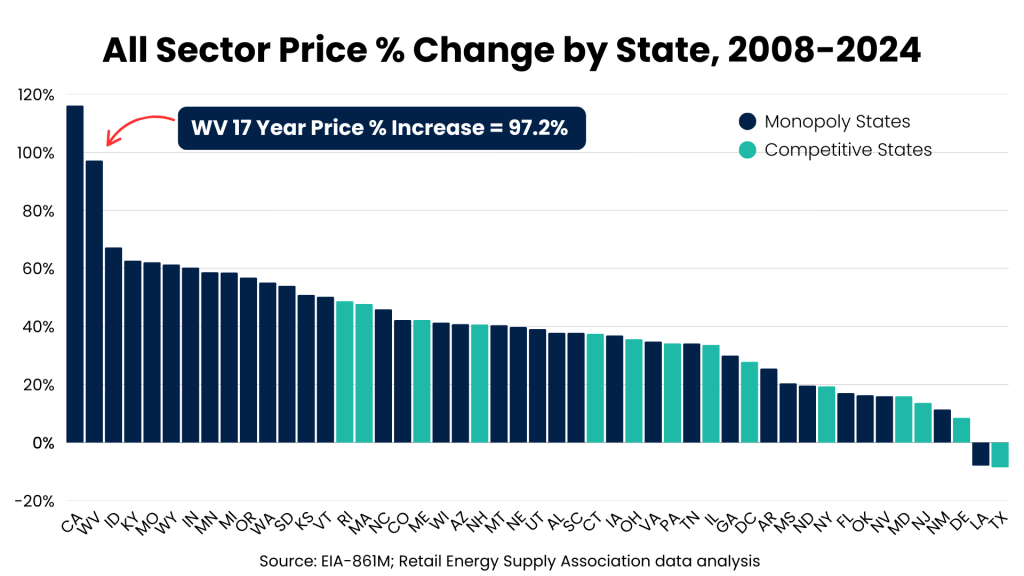
The often untold story on price is when states are compared based on price performance. When factoring in all consumer classes, Idaho actually ranks third worst among all states for its change in electricity price from 2008-2024. During that time, Idaho’s average electric price increased by more than 67%. Massachusetts ranked about 15 states better with a price change over the same time of less than 50%.

When comparing state prices based on performance over time, a factor that should be considered is whether the state operates under a monopoly market run by investor-owned utilities or if the state has restructured the electric market in any way to welcome competition.

Downward Price Pressure from Competition

Pennsylvania leaders voted to restructure the state’s energy market in 1996. Competition in power generation and electric supply has provided consumers with more affordable electricity options, including products at a lower price than electricity sold in 1996. But more importantly for all consumers in Pennsylvania, competition has applied downward price pressure on the utilities –– which still sell electricity –– keeping all prices more affordable. In fact, Pennsylvania consumers who were still receiving their electricity from their utility in 2024 were saving about 20% on their electric supply compared to what the rate would have been when an inflation adjustment is applied to the 1996 rate. This is a demonstration of downward price pressure because competition is present, preventing monopoly utilities from charging uncontested rates. 

The effect of competition and downward price pressure can be found in all consumer class electricity prices. When comparing all monopoly utility states to competitive states, non-residential (industrial and commercial) electric prices increased by nearly 40% between 2008-2024 in monopoly states. In contrast, electric prices for that same consumer class slightly decreased by .3%.

In looking at the price performance over time, not only did monopoly states prices increase significantly over time, but the average price for monopoly states also surpassed the average price for competitive states –– which decreased over time. 

When attempting to compare electricity prices, it helps to understand what makes up the price that’s being compared, and just as important, how prices have performed over time in the states that are being compared. In the end, price per kWh only scratches the surface of what defines market success. Price performance gives a better picture by measuring long-term consumer value.

Categories
Energy News

Competitive Energy Markets Provide Greater Resource Adequacy and Meet Energy Demands

From roughly 1990 to 2020, electricity markets operated in what could be called the “flat load era” — marked by slow, stable demand growth and a centralized, fuel-based generation mix. But since 2020, the landscape has shifted dramatically.

Drivers of this shift include: a surge in data center development, the push toward electrification of vehicles, buildings, and industry, and the rapid growth of intermittent renewable resources

During that same span of 30 years, some states began to change their electricity identity, converting from monopoly states, where vertically integrated utilities manage generation, transmission, and distribution, to competitive states where generation and supply are open to private investment and consumer choice.

With more than three decades of two different electric markets, it bears asking the question: which market structure is proving more capable of meeting this new wave of demand?

The data points to one clear answer: competitive electricity markets are outperforming monopoly states on resource adequacy, generation growth, and investment responsiveness.

Competition Meets Demand

As of 2023, competitive states now produce more electricity relative to their consumption than monopoly states — a complete reversal from 1997, when monopoly states generated around 8% more than competitive states.

Competitive states, such as Pennsylvania, are successfully serving as a net exporter of electricity, supporting load growth with generation growth. Additionally, competitive states are excelling at keeping price increases low or even better than before introducing competition. This shift underscores how competitive markets are better equipped to address today’s emerging demands facing electricity markets.

Competition Brings New Opportunities for Investment As Old Generation Retires

One major advantage of competitive markets is their ability to attract private capital when it’s needed — without relying solely on ratepayer-backed investments.

Utility companies in monopoly states that have been caught flat-footed through the flat load era, unable to see the change in energy demand ahead, are faced with an immense challenge of securing more power without financially harming their customers. This is also happening at a time when utilities were preparing to retire outdated baseload generation resources.

Take Indiana, for example. This is a state that is expecting 40% of its generation to be retired by 2035, while also expecting to see more than a 50% increase in demand. Using Lazard’s Levelized Cost of Energy report, it will cost –– conservatively –– $17 billion to build 22 new natural gas plants just to meet the projected 15,000 MW of new power generation needed by 2035.

Without private investment from competition, all $17 billion would be passed down to ratepayers through charges on their bills. This is after utility rates have already increased by 60% over 16 years –– and during that time, only less than 2,000 MW of new or updated power generation was built or completed.

But in states where competition is welcomed, private investments are made by energy companies to build new and efficient power plants, protecting all ratepayers from exorbitant and burdensome costs. Consumer classes can then ensure the security of more energy resources and shop for their supply at more affordable prices.

Competition Breeds Adequacy

Rapid growth in serving electrification and data centers, successful generation, and resource adequacy are paramount to market success.

As the U.S. grid transitions into a new era of complexity, the ability for consumers –– especially large energy users –– to procure their own electricity creates a diverse energy grid that is more reliable, more responsive, and more resilient. This approach for achieving a stronger grid protects ratepayers from the burdensome costs of utilities billing for the buildout of new power plants.

Sources: Information used in this blog includes data that was sourced from the U.S. Energy Information Administration, utility integrated resource plans (IRP), FERC Form 1, and Lazard’s 2025 Levelized Cost of Energy report.