
CHARLESTON, WV (June 30, 2026) –– A new report from the Cardinal Institute concludes that West Virginia is at a disadvantage in the “electricity backyard brawl,” with households spending a larger share of their income on electricity than residents of any neighboring state and businesses struggling to remain competitive. The report also highlights how neighboring states have adopted more competitive energy policies — including reforms similar to legislation introduced in the West Virginia Legislature this year.
Among the report’s key findings is that West Virginians devote a larger share of their household income to electricity than residents of Pennsylvania, Ohio, Kentucky, Virginia or Maryland. As the state pursues its goal of adding 35 gigawatts of new electric generation, the report warns that economic growth must be structured in a way that protects existing ratepayers from bearing the cost of new infrastructure.
The Retail Energy Advancement League (REAL) supported legislation introduced by Sen. Patricia Rucker and Del. Tristan Leavitt this legislative session that would establish a successful solution proven in neighboring states: Buy Your Own Power (BYOP). This model allows large energy users to find and procure their own power to operate their businesses instead of relying exclusively on utility-built generation financed by captive ratepayers.
“Large manufacturers and other energy-intensive employers shouldn’t have to wait for utilities to build new generation, and West Virginia families shouldn’t have to finance that growth,” said Chris Ercoli, president and CEO of the Retail Energy Advancement League. “Large energy users should have the flexibility to secure the electricity they need through competitive providers, allowing businesses — not families — to bear the cost of their own expansion.”
“Manufacturers and other large employers create jobs and drive West Virginia’s economy, but they can’t remain competitive if electricity becomes one of their largest operating expenses,” Ercoli continued. “BYOP gives those businesses the freedom to secure their own power while protecting families from the energy demands of large companies. If West Virginia wants to win a backyard brawl, it needs to prioritize proven solutions for its own communities.”
By creating an energy market for commercial and industrial businesses to secure their own electricity, West Virginia will attract private investments from independent power producers to build new power plants –– protecting ratepayers from funding new power plants built by investor-owned utilities.
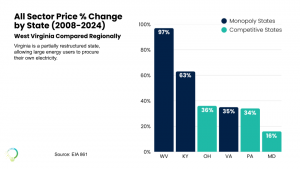
Data from the U.S. Energy Information Administration (EIA) reveals that West Virginia’s all-sector electricity price has increased by 97 percent in West Virginia from 2008-2024, the second worst price change in the country. The price for consumers in neighboring states –– Pennsylvania, Ohio, Virginia and Maryland –– have not increased more than 36 percent during that same time.
###
